Infrared thermography · NFPA 70B annual IR scan · data centers · BESS · USA
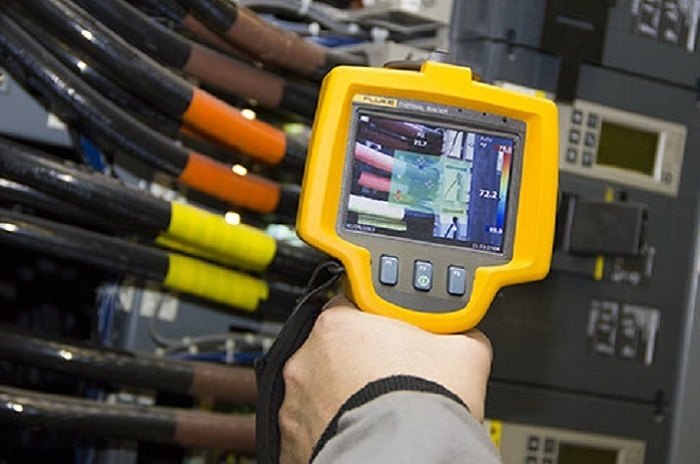
Your annual NFPA 70B infrared scan is due. VB scans your switchgear, UPS and battery storage under load and ranks every hot spot by severity.
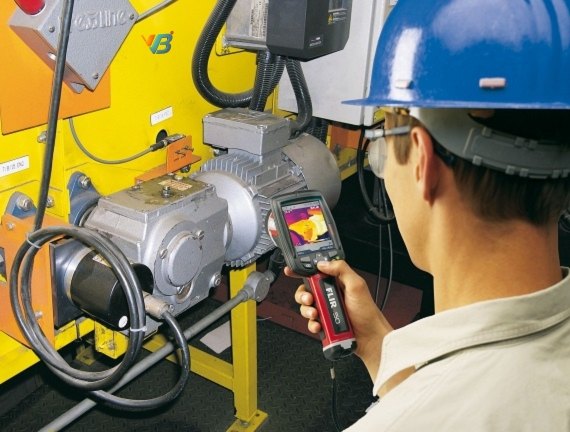
NFPA 70B (2023) sets infrared thermography of electrical equipment at least every 12 months, and every 6 months for equipment in Condition 3. VB scans switchgear, panelboards, UPS, PDUs, transformers and BESS enclosures under normal load, ranks each finding by temperature difference to ANSI/NETA MTS, and checks your arc flash label dates on the same visit.
Scanned under normal loadSeverity to ANSI/NETA MTSReport to NFPA 70B 7.4.3Arc flash label date checked
Your scan plan, now
| Scan scope | 106 assets 1 site |
|---|---|
| Field time | 4 scan days for a two-person team |
| NFPA 70B interval | Every 12 months · 1 scan a year |
| Report | Thermal and visible image per finding, delta-T, load at the time of scan, severity to ANSI/NETA MTS, repair priority, re-scan list |
| Arc flash | Labels dated before 2021: add the label date check to the same visit |
Modeled (category 3): VB scan-productivity model, October 2026, for a two-person team, equipment at normal operating load, covers opened or IR windows fitted, and access on agreed dates. A VB practice engineer turns these scan days into a fixed price for your facility. Short form, no phone number.
Trusted by the World's Most Demanding Plants.











- 0months, the NFPA 70B maximum interval for infrared thermography
- 0months when equipment is in Condition 3
- 0delta-T above which ANSI/NETA MTS calls for immediate repair
- 0assets twinned and recorded by VB
- 0countries
Intervals: NFPA 70B (2023) Table 9.2.2. Severity: ANSI/NETA MTS, similar components under similar load. Asset and country counts: VB Engineering project register.
How the scan plan works
- 1
Count the equipment
Switchgear sections, panels, UPS and PDUs, transformers and BESS enclosures, from your one-line or an asset list. No temperatures needed.
- 2
Read days and interval
The plan shows scan days, your NFPA 70B interval and whether your arc flash labels need checking, as you type.
- 3
Send it for a fixed price
A VB practice engineer confirms the count, schedules the scan around your load and maintenance windows, and sends a fixed price for the facility.
The requirement
How often does NFPA 70B require infrared thermography?
NFPA 70B, the Standard for Electrical Equipment Maintenance, became a standard with its 2023 edition and sets infrared thermography of electrical equipment at least every 12 months. Equipment rated Condition 3 after an equipment condition assessment moves to every 6 months. The 2026 edition keeps the periodic scan and, in Section 7.4.5, also recognizes permanently installed temperature sensors as a way to meet the thermal inspection duty.
| Equipment condition | What it means | Infrared thermography interval | What VB does on the visit |
|---|---|---|---|
| Condition 1 | Equipment meets expected physical and maintenance criteria, no open findings | Every 12 months | Full scan under load, baseline images kept for trending |
| Condition 2 | Results differ from previous scans or manufacturer guidance, or monitoring flags a change | Every 12 months | Full scan, flagged assets compared with last year's images |
| Condition 3 | Serious findings, unresolved notifications, or missed maintenance cycles | Every 6 months | Scan plus a re-scan list for repaired items |
| Nonserviceable | Equipment posing an immediate risk to personnel | Immediate action, not a scheduled scan | Finding reported the same day to the site contact |
Who asks a US facility for the scan?
NFPA 70E (2024) Section 205.3 requires equipment to be maintained to industry consensus standards, and NFPA 70B is that standard. Property insurers commonly ask for an annual infrared survey at renewal, and corporate safety and uptime programs schedule it. One VB report answers all three.
What VB scans
What equipment does an infrared electrical inspection cover?
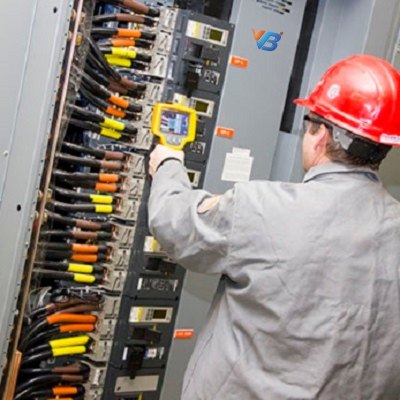
An infrared electrical inspection covers every energized connection that carries load: switchgear and switchboard sections, panelboards, MCCs and disconnects, busway joints and taps, transformer terminals, UPS modules, PDUs and remote power panels, generator paralleling gear, and BESS power conversion systems, combiners and enclosures. VB scans each one under normal operating load so a loose or overloaded connection shows its real temperature rise.
| Asset | What the scan looks for | Access VB plans for |
|---|---|---|
| Switchgear and switchboards | Bus joints, breaker stabs, cable lugs, CT terminals | Covers opened under an energized work permit, or IR windows |
| Panelboards, MCCs, disconnects | Branch breaker terminals, fuse clips, starters, neutral bars | Dead-front removal by the site electrician |
| UPS, PDUs, RPPs | Input and output terminals, DC links, battery strings | Normal load, never on bypass, outside a maintenance window |
| Transformers | Bushings, tap connections, cooling fins, load balance | Line of sight from the safe approach distance |
| BESS enclosures and PCS | DC combiners, inverter terminals, HVAC and enclosure hot spots | Scheduled in a charge or discharge window |
| Motors and drives | Bearings, terminal boxes, drive heat sinks | Running at duty load |
The price
How much does an infrared electrical inspection cost?
VB prices an infrared electrical inspection as a fixed figure per facility, built from the scan days and the report, and scan days are set by the asset count, not the floor area. A two-person VB team typically covers about 30 switchgear sections, 60 panelboards, 20 UPS or PDU units, 10 transformers or 6 BESS enclosures in a day on VB's modeled rates. The scan plan above turns your counts into days; the practice engineer turns them into a fixed price for your facility.
Bolted switchgear covers without IR windows need an energized work permit and a site electrician per section.
Data halls on low load, UPS on bypass or BESS idling show nothing. Scans are booked into working hours, which can mean nights.
Travel and a report per site.
Six-monthly scans and a re-scan list double the visits for that equipment until it moves back to Condition 1 or 2.
Windows on switchgear let the thermographer scan without opening covers, which roughly halves the time at each lineup.
When VB is already on site for arc flash data collection or the label check, the scan shares the travel, escorts and permits.
Scan-day rates: VB scan-productivity model, October 2026, modeled (category 3), two-person team, normal access. The quoted price follows the scan plan.
What you receive
What does an NFPA 70B thermography report include?
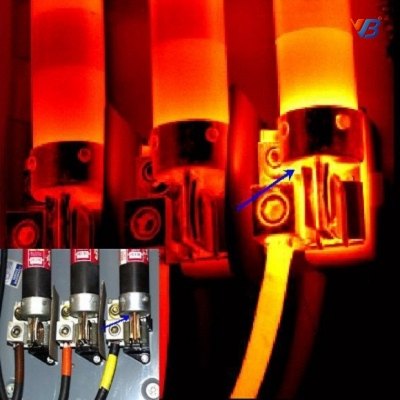
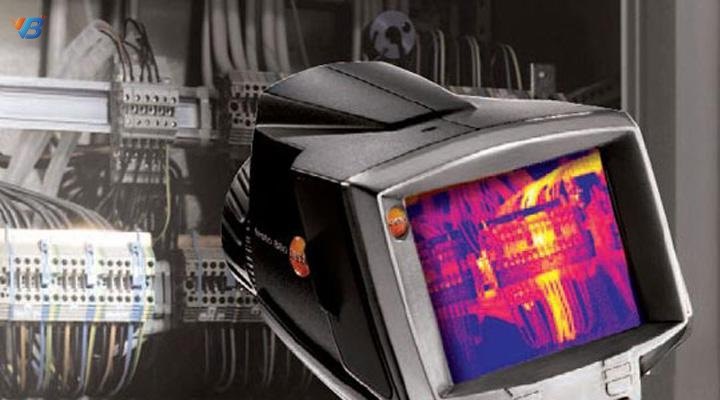
An NFPA 70B thermography report records, for every finding, the thermal and visible image, the temperature difference between the hot component and a similar reference component, the load at the time of the scan, the emissivity and reflected temperature used, and the severity with a recommended action. It also names the thermographer and the imager, because Section 7.4.3 requires temperature differences to be documented.
- Finding sheet per hot spot · thermal and visible image, location, asset ID
- Delta-T and load · against a similar component under similar load
- Severity and priority · ANSI/NETA MTS bands, repair before next scan or immediately
- Re-scan list · repaired items checked on the next visit
- Arc flash label check · study date and legibility recorded per bus
- Baseline images · kept so next year compares like with like
What temperature difference is a problem?
| Delta-T between similar components | Meaning | Action |
|---|---|---|
| 1 °C to 3 °C | Possible deficiency | Investigate |
| 4 °C to 15 °C | Probable deficiency | Repair as time permits |
| Above 15 °C | Major discrepancy | Repair immediately |
Where VB scans
How is infrared thermography done in data centers and battery storage sites?
In a data center VB scans the power chain from the utility switchgear through UPS, PDUs and remote power panels at normal IT load, one redundant path at a time so uptime is never at risk. On a battery energy storage site VB scans the power conversion system, DC combiners, inverter terminals and MV switchgear during a scheduled charge or discharge window, because an idle battery shows no thermal fault.
Data centers
Utility and generator switchgear, UPS modules, battery strings, PDUs and RPPs, scanned path by path under IT load inside your change-control window.
BESS and power
PCS and inverter terminals, DC combiners, MV switchgear, step-up transformers and substation connections, scanned during a planned charge or discharge so the connections carry real current.
Pharma and semiconductor
Electrical rooms that feed cleanrooms, process tools and HVAC, scanned without entering classified areas.
One visit, two duties
Should infrared thermography be done with an arc flash study?
Yes, when both are due: the thermographer opens the same equipment the arc flash study records, so one visit can scan every connection, collect the arc flash field data and check the date on every label. NEC 2026 Article 110.16(B) requires the study date on the arc flash label, so a study completed before 2021 is visibly out of date at inspection, and the scan is where it gets noticed.
| On the same visit | What you get | Where it goes next |
|---|---|---|
| Infrared scan | Hot spots ranked by severity, report to NFPA 70B | Your maintenance work orders |
| Arc flash label date check | Every label read, dated and photographed | A priced arc flash study if labels pre-date 2021 |
| Arc flash field data | Nameplates, settings and cable data recorded in ElecTwin® | The study scope of work, modeled in ETAP or SKM |
Tool expertise
Which software do VB's arc flash teams work in?
VB has dedicated engineering teams with hands-on expertise in ETAP, SKM PowerTools, CYME, EasyPower, PSS®E and NEPLAN. When the scan or the label check leads to an arc flash study, it runs in whichever software your facility or corporate electrical standard already uses.
A scan, planned
What does a data center scan look like from count to report?
A modeled colocation data center in the US mid-Atlantic, two data halls and a central plant: 36 switchgear and switchboard sections, 140 panelboards and RPPs, 24 UPS modules and PDUs, 8 transformers, labels from a study completed before 2021, equipment maintained with no open findings. On VB's scan-productivity model this is a six-day scan for a two-person team, split across the A and B power paths so each path is scanned under load while the other carries the IT load.
| Line | Count | Modeled scan time |
|---|---|---|
| Switchgear and switchboard sections | 36 | 1.2 days |
| Panelboards and RPPs | 140 | 2.3 days |
| UPS modules and PDUs | 24 | 1.2 days |
| Transformers | 8 | 0.8 days |
| Total, rounded to whole days | 208 assets | 6 scan days, interval every 12 months |
Modeled, illustrative (category 3): VB scan-productivity model, October 2026, for a site of this shape; not a record of any one project. Because the labels pre-date 2021, the label date check runs on the same six days.
Why facilities book VB for the annual scan
A thermography report written by the engineers who run arc flash studies
Every finding carries the load at the time of the scan, so a hot spot is a measurement, not a guess.
Delta-T against a similar component, ranked to ANSI/NETA MTS, with a repair priority per finding.
Report content follows Section 7.4.3, with the thermographer and the imager named on it.
The NEC 2026 110.16(B) study date is read on every label the scan passes.
Where permanent temperature sensors under NFPA 70B 7.4.5 would pay back, VB says which lineups and why.
Baseline images and asset IDs are kept so the next scan trends each connection.
Before you book
Questions facility and electrical managers ask VB about infrared thermography
How much does an infrared electrical inspection cost?
VB prices an infrared electrical inspection as a fixed figure per facility, built from the scan days and the report, and scan days come from the asset count, not the floor area. On VB's modeled rates a two-person team covers about 30 switchgear sections, 60 panelboards, 20 UPS or PDU units, 10 transformers or 6 BESS enclosures a day. Enter your counts in the scan plan on this page and a VB practice engineer returns a fixed price for your facility.
How often are infrared inspections required under NFPA 70B?
NFPA 70B (2023) Table 9.2.2 sets infrared thermography of electrical equipment at least every 12 months for equipment in Condition 1 or 2, and every 6 months for equipment in Condition 3, which covers serious findings, unresolved notifications or missed maintenance cycles. Nonserviceable equipment calls for immediate action rather than a scheduled scan.
Is NFPA 70B enforceable by OSHA?
OSHA enforces electrical safety through its own regulations and the General Duty Clause, and it uses industry consensus standards as the measure of recognized practice. NFPA 70E (2024) Section 205.3 requires equipment to be maintained to the manufacturer's instructions or industry consensus standards, and NFPA 70B is that standard. Insurers, authorities having jurisdiction and corporate safety programs reference it directly.
Does my property insurer require an annual infrared scan?
Many commercial property insurers and their loss-control engineers ask for an annual infrared survey of electrical equipment at renewal, and some write it into the policy conditions. VB's report is written to NFPA 70B Section 7.4.3, with images, delta-T, load, severity and the thermographer named, which is the content a loss-control engineer looks for. Check the wording in your own policy schedule.
What does an NFPA 70B thermography report include?
For every finding: the thermal and visible image, the asset and location, the temperature difference against a similar component under similar load, the load at the time of the scan, emissivity and reflected temperature, severity and recommended action. The report also names the thermographer, their qualification and the imager used, and keeps baseline images so the next scan can trend each connection.
What temperature difference is a problem in an electrical panel?
ANSI/NETA MTS Table 100.18 grades the temperature difference between similar components under similar load: 1 to 3 °C is a possible deficiency to investigate, 4 to 15 °C a probable deficiency to repair as time permits, and above 15 °C a major discrepancy to repair immediately. Delta-T does not predict time to failure, so VB reports every anomaly with a priority.
Can continuous thermal monitoring replace the annual IR scan?
The 2026 edition of NFPA 70B, in Section 7.4.5, recognizes permanently installed temperature sensors as a way to meet the thermal inspection duty for the connections they cover. Sensors watch the points they are fitted to; a scan sees everything in the cubicle. VB scans the site, then advises which lineups would pay back a sensor retrofit.
How do you scan a battery energy storage system?
VB scans a BESS site during a scheduled charge or discharge window, because an idle battery carries no current and shows no thermal fault. The scan covers the power conversion system and inverter terminals, DC combiners, MV switchgear, step-up transformers and the enclosure exterior, with the load recorded on every finding and access agreed with the site operator.
Should UPS, PDUs and switchgear be scanned under load?
Yes. A loose or overloaded connection only shows its temperature rise when current flows through it, and NFPA 70B Section 7.4.1 compares similar components under similar load. VB never scans a UPS on bypass, and in a data center scans one redundant power path at a time so the other carries the IT load.
Should infrared thermography be done with an arc flash study?
When both are due, yes. The thermographer opens the same equipment the arc flash study records, so one visit can scan every connection, collect arc flash field data and read the study date on every label. Under NEC 2026 Article 110.16(B) the label carries the study date, so labels from a study before 2021 are flagged on the same visit.
What happens after I send the scan plan?
A VB practice engineer reads your asset counts, condition and arc flash label answer, confirms the scan days and load windows, and replies with a fixed price for the facility, the schedule and the report scope. If your labels pre-date 2021 the reply also prices the label date check on the same visit. No call unless you ask for one.
Count your equipment, read your scan days, send it for the price.
A VB practice engineer confirms the count, schedules the scan around your load windows and replies with a fixed price for your facility and the report scope.
Get price estimatePrefer email? Write to connect@groupvb.com with your asset count in the subject line.