PESO · Petroleum Rules 2002 · Rules 103 to 106 and 114 · IS 5572
PESO wants a hazardous area drawing, or you have modified a licensed solvent area? Here is what the Petroleum Rules require and how to close it.
Under the Petroleum Rules 2002, an area where petroleum below 65 °C flash point or a flammable gas is likely to be present is a hazardous area (Rule 103). It is graded Zone 0, 1 or 2 (Rule 104), the zone decides which electrical apparatus may be installed (Rule 106), and a competent person must certify the circuits before first use and after every alteration (Rule 114).
Rules 103, 104, 105, 106, 114Zones drawn to IS 5572:2009Existing equipment checked against the zoneDrawings ready for the licence file
Is a new hazardous area drawing or Rule 114 certificate due? Check in 60 seconds
The check reads your answers against Rules 103 to 106 and 114 of the Petroleum Rules 2002. It is a screening, not legal advice. Press the button and a VB engineer replies by email within one business day with the scope and the price in INR.
Trusted on plants that cannot stop










The rules
What do the Petroleum Rules 2002 require for hazardous areas?
The Petroleum Rules 2002 require every licensed place where petroleum is refined, blended, stored, loaded or unloaded to treat its hazardous areas by zone. Rules 103 to 105 define the hazardous area, the three zones and their extent; Rule 106 limits the electrical apparatus in each zone; and Rule 114 requires a signed certificate before first use and after every repair or alteration.
| Rule | What it says | What it means for your plant |
|---|---|---|
| 102 | No electric wiring or apparatus in a refinery, installation, storage shed or service station except as the chapter provides | Electrical work in a licensed area follows Chapter IV |
| 103 | A hazardous area is one where petroleum below 65 °C flash point, or a flammable gas or vapour in an ignitable concentration, is likely to be present | Solvent and fuel handling areas are hazardous areas |
| 104 | Zone 0: gas continuously present. Zone 1: likely in normal operation. Zone 2: only on abnormal conditions or equipment failure. The Chief Controller decides disputes | Each area must be graded |
| 105 | The extent of the hazardous area is as laid down in the Fourth Schedule; the Chief Controller may vary it | Zone boundaries are drawn to the schedule and the plant's release sources |
| 106 | No apparatus in Zone 0 except approved intrinsically safe; Zone 1 apparatus flameproof or intrinsically safe of an approved type | The zone decides what you may buy and install |
| 114 | Before first energising, and after each repair, maintenance or alteration, a competent person certifies the circuit and apparatus; the occupier keeps it for the Inspector | Every change in a classified area needs a new certificate |
Text from the Petroleum Rules 2002 (G.S.R. 204(E), 13 March 2002). Check the current official text and your licence conditions with PESO before relying on any clause.
The drawing
What should a hazardous area drawing for a PESO licence show?
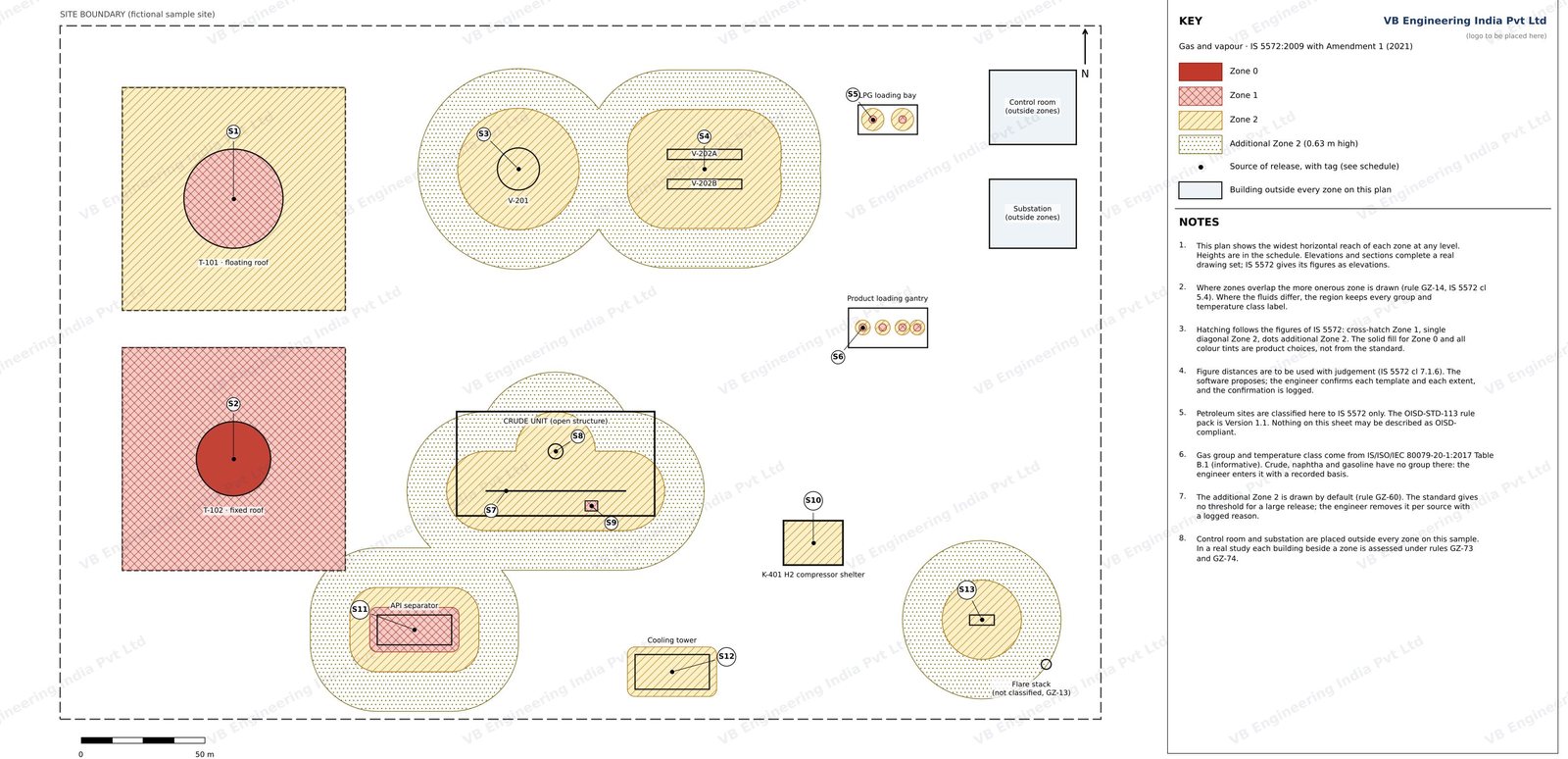
A hazardous area drawing for a PESO licence should show every tank, pump, vent, loading point and building in the licensed area, the zone around each release source with its dimensions in plan and elevation, the electrical equipment inside each zone with its protection type, and the standard used, normally IS 5572:2009.
- Layout to scale matching the licensed site plan.
- Release sources marked: tank vents, pump seals, hose connections, drum filling points.
- Zones 0, 1 and 2 with extents dimensioned, in plan and elevation.
- Electrical apparatus in each zone with protection type, gas group and temperature class.
- Basis: IS 5572:2009, material flash points and ventilation assumptions, signed.
After a change
When does a modification need a new hazardous area classification and a Rule 114 certificate?
Any repair, maintenance or alteration to a circuit or apparatus in a hazardous area needs a fresh Rule 114 certificate before it is energised. The zone drawing itself needs revising when the change adds or moves a release source, changes ventilation, brings in a new material, or puts new electrical equipment into a classified area.
| Change | Revise zone drawing? | New Rule 114 certificate? |
|---|---|---|
| New tank, pump, vent or loading point | Yes | Yes, for any electrical work in the area |
| New solvent or fuel with a lower flash point | Yes | Yes, if apparatus must change |
| Ventilation changed or a room enclosed | Yes | Yes, if apparatus is affected |
| Motor, light fitting or junction box replaced | No, if the source is unchanged | Yes |
| Repair or maintenance on an Ex enclosure | No | Yes |
Who it applies to
Is hazardous area classification mandatory for a chemical or pharma factory in India?
Yes. Hazardous area classification is required wherever petroleum is refined, blended, stored, loaded or unloaded under the Petroleum Rules 2002, and in fuel outlets, LPG plants and terminals under the PNGRB technical standards. Factories handling flammable gas, vapour or dust must exclude ignition sources from those areas, and the zone drawing is how a plant shows its inspector, insurer and auditor that it has.
| Site | Requirement | Source |
|---|---|---|
| PESO-licensed petroleum storage and handling, including a factory's solvent or fuel tank farm | Zones and permitted apparatus; certificate after alteration | Petroleum Rules 2002, Rules 103 to 106 and 114 |
| Fuel retail outlets | "Hazardous area classification shall be done in line with IS: 5572" | PNGRB Retail Outlet T4S, Sch-I 3.1(ix) |
| Depots and terminals of 1,000 KL and above | Layout drawing with hazardous areas demarcated, per IS 5572:2009 | PNGRB Petroleum Installation T4S, Sch-1 Part A 1.1(10) |
| Factories with flammable gas, vapour or dust | Prevent explosion and exclude ignition sources from the area; the zone drawing is the evidence | Factory safety obligations; insurer and audit requirements |
| Insured plants | Area classification and equipment approved for each area | Insurer risk-engineering guidelines |
This page explains requirements in plain terms; your PESO licence states what is licensed at your site. It is not legal advice.
How VB closes it
How does VB prepare the drawing and support the Rule 114 certificate?
VB walks the licensed area, lists release sources against the site plan, assigns zones and extents to IS 5572:2009, checks every electrical item against its zone, and issues the signed drawing, equipment register and action list your competent person needs to certify the circuits.
- Site walk against the licensed layout; changes since the last drawing recorded.
- Zones and extents drawn in plan and elevation to IS 5572:2009.
- Equipment check of protection type, gas group, temperature class and certificate.
- Action list for anything unsuitable, before the certificate is signed.
- Signed drawing and report for the licence file. For the full study scope, see hazardous area classification in India.
Before you ask
Questions licence holders ask about hazardous area drawings
Who can prepare a hazardous area drawing for a PESO licence?
An engineering firm with experience of IS 5572 and the Petroleum Rules, which walks the site and signs the drawing. Check the licence conditions for who must sign each document.
Which standard does the drawing follow?
IS 5572:2009 for the classification, with equipment selected to the IS/IEC 60079 series. The PNGRB standards for outlets and terminals name IS 5572 directly.
What is the Rule 114 certificate?
A certificate by a competent person that the circuits and apparatus in a hazardous area have the safety characteristics for which their use was approved. It is issued before first energising and after every repair, maintenance or alteration, and kept for the Inspector.
Do we need a new drawing if we only replaced a motor?
Usually not, if the release sources are unchanged, but the replacement must suit the zone and a new Rule 114 certificate is needed before it is energised.
What equipment is allowed in Zone 1?
Flameproof or intrinsically safe apparatus of a type approved in writing by the Chief Controller, under Rule 106(2). Zone 0 allows only approved intrinsically safe apparatus where its use cannot be avoided.
Does this apply to a pharma plant's solvent store?
Where the solvent store is licensed by PESO under the Petroleum Rules, yes. Your licence document states what is stored and licensed, and the zone drawing covers every licensed area.
How long does the drawing take?
It depends on the number of tanks, loading points and buildings in the licensed area; the quote states the site days and delivery time. A current site plan and equipment list shorten it.
How do we get a price?
Use the check at the top of this page or email the licence type, the areas involved and the state of your drawings. A VB engineer replies with the scope and an INR price within one business day.
Send your licensed layout. Get the zones, the equipment check and an INR price in one business day.
Tank farm, solvent store, drum filling or loading bay, anywhere in India: a VB engineer replies with the scope and the price, by email.
Get price estimateRather write? Email connect@groupvb.com with "PESO hazardous area drawing" in the subject.