Arc flash study cost · India · priced per bus · IEEE 1584-2018 · NFPA 70E · CEA 2023
How much does an arc flash study cost in India? From ₹1.25 lakh, priced per bus, assumptions beside every figure.
An arc flash study in India is priced per bus, not per day. VB's modelled band is ₹2,500 per LT bus and ₹5,000 per HT bus for the study and signed report, with a ₹1.25 lakh minimum, field data collection and labels as separate lines, and 18% GST on top. A 40-panel plant lands between ₹1.5 and ₹2.1 lakh all in. Count your buses below and take the band to your manager now.
1,000+ studies since 2014Per bus, not per dayAssumptions beside every figureSigned by a Chartered EngineerGet your arc flash report reviewed by a Chartered Electrical Safety Engineer (CESE)
Your arc flash study price band in 30 seconds
| Study and signed report | |
|---|---|
| Field data collection | |
| Labels, installed | |
| Indicative total, ex GST | |
| Typical duration |
Modelled band, not a quote. Built on the VB rate card below with its assumptions; 18% GST and travel at actuals are extra. Press the button and a VB engineer emails a line-by-line fixed price within one business day. No call unless you ask.
Trusted on plants that cannot stop










- ₹2,500per LT bus for the IEEE 1584-2018 study and signed report, modelled VB rate
- ₹5,000per HT bus, 3.3 kV to 33 kV, same deliverable
- ₹1.25 lakhminimum engagement, so a ten-panel study is never priced below the engineering it takes
- 5 yearsthe longest a study may run before review under NFPA 70E 130.5(G), so the price is spread over five years of labels
- 0arc flash studies delivered by VB since 2014
Rates are Category 3 modelled figures from VB's India pricing model, October 2026, ex GST, assumptions in the rate card below. Sources: NFPA 70E 130.5(G) · IEEE 1584-2018. Study count: VB Engineering project register.
The rate card
How much does an arc flash study cost in India per bus?
An arc flash study in India costs about ₹2,500 per LT bus and ₹5,000 per HT bus for the IEEE 1584-2018 calculation and a signed report, with a ₹1.25 lakh minimum, under VB's modelled rate card for October 2026. Field data collection adds ₹600 per bus plus travel, installed labels add ₹350 each, and 18% GST applies to all lines. A bus is one panel section with its own incident energy value, so a plant with 40 panels has about 40 buses.
| Line | Modelled rate | What it covers | Assumption behind the rate |
|---|---|---|---|
| LT bus, 415 V | ₹2,500 per bus | Short circuit, protective device data, IEEE 1584-2018 incident energy and boundary, result sheet per bus, signed report | Single site, ETAP or SKM model built by VB, drawings available |
| HT bus, 3.3 kV to 33 kV | ₹5,000 per bus | As above, with relay data, CT ratios and clearing times verified for each HT breaker | Relay settings available or read on site |
| DC or BESS bus | ₹3,500 per bus | DC incident energy to the NFPA 70E Annex D method for battery, UPS and PCS buses | Battery and converter data from the OEM |
| Field data collection | ₹600 per bus, plus travel at actuals | Walkdown, nameplate and setting capture, single line diagram reconciled to the field | Priced only where drawings are outdated or missing |
| Labels, printed and installed | ₹350 per label | One label per bus door, printed from the study, fixed and photographed | English plus one regional language; floor marking quoted per switchroom |
| Minimum engagement | ₹1,25,000 | Study and report for any plant below about 40 LT buses | Covers model build, review and signature regardless of size |
| GST | 18% | On every line above | Engineering services, invoiced from Hyderabad |
Three things to know about the card. The rates are a model, labelled so, and the band VB quotes from them runs from 0.9 to 1.3 times the model until a one-day scoping review fixes the price. Relay coordination, load flow and short circuit studies ordered together with the arc flash study are priced on their own lines and usually lower per bus, because the model is built once. And a plant whose single line diagram is current pays nothing for field data, which is the single largest saving available to a buyer.
Worked examples
What does an arc flash study cost for a 40-panel, 70-panel or 300-panel plant in India?
A 40-panel plant with a partly outdated single line diagram costs about ₹1.5 to ₹2.1 lakh ex GST for the study, field data and installed labels, under VB's modelled rates. A 70-bus pharmaceutical site lands between ₹2.4 and ₹3.5 lakh, and a 300-bus integrated plant between ₹9.9 and ₹14.3 lakh. Each figure below is built line by line from the rate card, so your own count slots in directly.
| Plant | Buses | Study and report | Field data | Labels | Indicative total | Typical duration |
|---|---|---|---|---|---|---|
| Small process plant, one substation | 34 LT + 6 HT | ₹1.25 lakh (minimum applies) | ₹24,000 | ₹14,000 | ₹1.5 to ₹2.1 lakh | 4 to 5 weeks |
| Pharmaceutical formulation site, two substations | 60 LT + 10 HT | ₹2.0 lakh | ₹42,000 | ₹24,500 | ₹2.4 to ₹3.5 lakh | 5 to 7 weeks |
| Integrated plant, 33 kV intake, eight substations | 250 LT + 40 HT | ₹8.25 lakh | ₹1.74 lakh | ₹1.02 lakh | ₹9.9 to ₹14.3 lakh | 10 to 14 weeks |
The first example is the plant most Indian buyers describe when they ask for a price: around 40 panels, HT intake, one or two LT switchrooms. The minimum engagement sets the study line, which is why the per-bus figure matters less below 40 buses than the lines around it. Above 100 buses the per-bus rate is the whole story, and the duration grows with the number of substations rather than with the bus count alone.
What moves the price
What decides the cost of an arc flash study in India?
Five things decide the cost of an arc flash study in India: the number of buses, the share of HT buses, the state of the single line diagram and protection settings, whether labels and floor marking are included, and how many sites or substations the engineer must visit. Plant size in MW or square metres does not set the price; the bus count does.
| Driver | Why it changes the figure | What to send us |
|---|---|---|
| Bus count | Every bus is modelled, calculated and reported on its own | Number of HT panels, PCCs, MCCs and distribution boards |
| HT share | Relay data, CT ratios and clearing times take longer to verify than LT breaker curves | Voltage levels and the number of HT breakers |
| Drawing status | A current single line diagram removes the field survey line entirely | Year of the last single line diagram update and who holds the relay settings |
| Labels and marking | Printed, installed and photographed per bus; marking per switchroom | Whether labels are wanted now and in which languages |
| Sites and substations | Each substation is a walkdown day; each site is a travel line | Number of sites, substations and their locations |
Scope
What is included in the arc flash study price, and what is not?
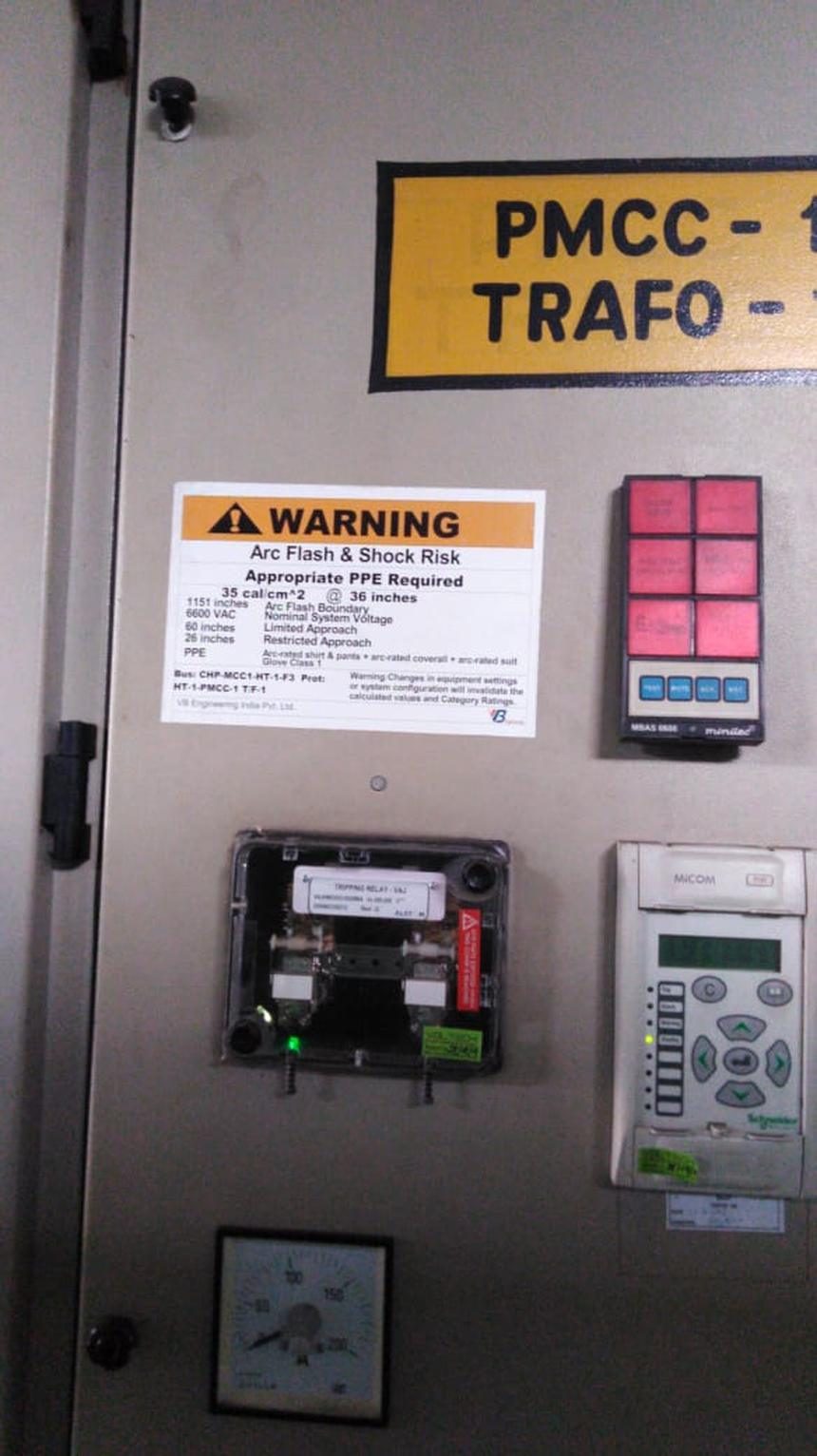
The arc flash study price in India includes the power system model, the short circuit and protective device study, the IEEE 1584-2018 incident energy and arc flash boundary for every bus, the PPE category per bus, the label schedule and a report signed by a Chartered Engineer. It does not include field data collection, printed labels, floor marking, relay resetting, training or PPE supply, which are quoted as separate lines so the buyer sees each one.
| Included in the study price | Quoted separately |
|---|---|
| ETAP or SKM model of the network from the utility intake to the last distribution board | Field data collection and single line diagram reconciliation, ₹600 per bus plus travel |
| Short circuit study and protective device data per bus | Labels printed, installed and photographed, ₹350 per label |
| Incident energy, arc flash boundary and working distance per bus to IEEE 1584-2018 | Arc flash boundary floor marking, per switchroom |
| PPE category per bus under NFPA 70E 130.5 and the IEC 61482 clothing class it maps to | Relay coordination, load flow and harmonic studies, on their own lines |
| Mitigation list where a bus exceeds 40 cal/cm², with setting changes proposed | Implementing setting changes and retesting relays |
| Label schedule, one row per bus, ready for print | Operator training on reading labels and PPE |
| Report signed by a Chartered Engineer, with the model files | Arc-rated PPE supply |
Why the split matters: a lump-sum quote that bundles field data into "the study" cannot be compared with one that does not, and a plant with current drawings ends up paying for a survey it does not need. Ask every bidder for the same seven included lines and the same seven excluded ones, and the quotes line up.
Pricing models
Per bus, per day or lump sum: which arc flash study pricing is right for an Indian plant?
Per-bus pricing is the only model in which the buyer can check the quote against the plant, because the bus count is known before the work starts. Per-day pricing, common in Indian quotations at ₹25,000 to ₹35,000 a day, leaves the total open until the engineer leaves site. A lump sum is fine when it lists the bus count and the exclusions it was built on, and not otherwise.
| Model | How the total is set | What the buyer can check | Where it goes wrong | VB position |
|---|---|---|---|---|
| Per bus | Rate × bus count, by voltage level | Bus count from the single line diagram before ordering | Needs an agreed definition of a bus (one panel section, one value) | Standard |
| Per day | Day rate × days on site and in the office | Nothing until the job ends; days are the vendor's estimate | Field days grow with poor drawings, the buyer carries the overrun | Not offered |
| Lump sum | One figure for a described scope | Only if bus count, exclusions and revisions are written in | Scope creep argued after the order; labels and travel appear as extras | Offered as a fixed price after the scoping review |
Method and timeline
How is an arc flash study done in India, and how long does it take?
An arc flash study in India runs in six steps over four to seven weeks for a plant of up to 100 buses: scoping, data collection, model build, short circuit and protective device study, IEEE 1584-2018 incident energy calculation, and the signed report with the label schedule. The plant's time is one scoping call, one walkdown window and one review of the draft; VB does the rest off site.
| Step | What happens | What the plant provides | Typical time |
|---|---|---|---|
| 1 · Scoping | Bus count agreed from the single line diagram, exclusions written, price fixed | Single line diagram, panel list, last study if any | 1 to 3 days |
| 2 · Data collection | Nameplates, cable data, breaker and relay settings captured; drawings reconciled | Escort and access during a planned window | 2 to 5 days on site |
| 3 · Model build | Network built in ETAP or SKM from the utility intake down | Utility fault level letter | 1 week |
| 4 · Short circuit and protection | Fault currents and clearing times per bus; miscoordination noted | Nothing | 1 week |
| 5 · Incident energy | IEEE 1584-2018 calculation per bus, boundary, PPE category, mitigation list | Nothing | 3 to 5 days |
| 6 · Report and labels | Draft reviewed with the plant, signed report issued, label schedule released for print | One review meeting | 1 week |
Studies above 100 buses or across several sites run longer, mainly in step 2, and the price band already carries that. The study is reviewed by a second VB engineer before signature.
Tool expertise
Which software does VB use for arc flash studies in India, and does it change the price?
VB builds Indian arc flash studies in ETAP or SKM PowerTools as standard, with teams also working in CYME, EasyPower, PSS®E and NEPLAN, and the choice of tool does not change the per-bus price. The plant receives the model files with the report, so the next study, five years on, starts from a model rather than from zero.
Worked case · pharmaceutical · Telangana
What did a 70-bus pharmaceutical site in Telangana pay for its arc flash study, line by line?
A pharmaceutical formulation site in Telangana with 60 LT buses, 10 HT buses and two substations is priced at ₹2.0 lakh for the study and signed report, ₹42,000 for field data because its single line diagram predated a new chiller plant, and ₹24,500 for 70 installed English-Telugu labels, giving ₹2.67 lakh at the model and a quoted band of ₹2.4 to ₹3.5 lakh ex GST. This is a modelled example on the VB rate card, labelled as such; the plant type and counts match the pharma sites VB studies in Telangana.
Where the money went
Seventy-five percent of the figure is engineering: the model, the protection study and the per-bus calculation. Field data is 16 percent and would have been zero with a current drawing. Labels are 9 percent and are the only part of the study an operator ever sees.
What the plant could have saved
Updating the single line diagram in house before the study removes the ₹42,000 line. Ordering the relay coordination study on the same model adds its own line at a lower per-bus rate than a standalone study, because steps 2 to 4 are shared.
Why plants in India price their study with VB
Why do Indian plants take VB's arc flash study price to their management?
The band is on the page. The quotation confirms it line by line.
Every rate carries the assumption it was built on, so the buyer can check it.
Current drawings mean the field line reads zero.
A Chartered Engineer signs; a second engineer reviews before signature.
Pharma, power, solar and BESS, terminals, steel, chemicals, cement and IT campuses.
Model files handed over, so the five-year review starts from a model.
Before you ask
Questions Indian plants ask about arc flash study cost
How much does an arc flash study cost in India for 40 panels?
About ₹1.5 to ₹2.1 lakh ex GST with field data and installed labels, or ₹1.25 lakh for the study and report alone, under VB's modelled rate card. The ₹1.25 lakh minimum engagement applies below about 40 LT buses, so the lines around the study, not the per-bus rate, decide the figure at this size.
What is the arc flash study cost per panel in India?
₹2,500 per LT bus and ₹5,000 per HT bus on VB's October 2026 rate card, for the IEEE 1584-2018 study and a signed report. A panel section with its own incident energy value is one bus, so for most plants the panel count and the bus count are the same number.
Why is an arc flash study priced per bus and not per plant?
Because every bus is modelled, calculated and reported on its own. Two plants of the same MW rating can have 30 buses or 300. Per-bus pricing lets the buyer check the quote against the single line diagram before ordering, which per-day or per-plant pricing cannot offer.
Is GST charged on an arc flash study in India?
Yes, 18% on engineering services, on every line of the quotation. Compare quotations ex GST, then add 18% to the chosen one for the purchase order.
Does the price include labels and boundary marking?
No. Labels are ₹350 each, printed from the study, installed and photographed, and floor marking is quoted per switchroom. They are separate lines so a plant that wants the study first and the labels after a budget approval can order them that way. See arc flash labels and boundary marking in India.
What if our single line diagram is outdated?
Field data collection is added at ₹600 per bus plus travel, and the drawing is reconciled to the field during the walkdown. Updating the drawing in house before the study removes that line. A study built on an outdated drawing produces wrong labels, so VB does not skip this step to lower the price.
Is an arc flash study mandatory in India, and does that change the price?
CEA 2023 Regulation 21(2)(b) requires that persons working on electrical apparatus be protected from injury due to arc flash to the relevant standards, and insurers, parent companies and USFDA-facing audits ask for the study by name. The requirement does not change the price; the bus count does. For the regulation in full see arc flash hazard analysis and CEA 2023 compliance.
How often must the study be repeated, and what does the review cost?
NFPA 70E 130.5(G) sets a review at least every five years, or sooner after a change to transformers, cables, DG sets or protection settings. A review on a VB model is priced per changed bus rather than per plant, which is why the model files are handed over with the first study. See arc flash risk assessment in India.
Can we get a lower price by ordering relay coordination and load flow together?
Yes. The three studies share the model, the data collection and the short circuit results, so relay coordination and load flow ordered with the arc flash study are priced on their own lines at lower per-bus rates than standalone studies.
What does a quote of ₹30,000 a day actually cost?
It depends on days nobody has counted yet. A 70-bus plant with outdated drawings takes about 4 site days and 10 office days under a day-rate model, which is ₹4.2 lakh before labels, travel and GST. Ask any day-rate bidder for the day count in writing and convert it to a per-bus figure before comparing.
How fast can VB quote, and what do you need from us?
Within one business day of the enquiry, by email, with every line priced. Send the number of HT and LT panels, the voltage levels, the year of the last single line diagram update and whether labels are wanted. The calculator at the top of this page asks for exactly those four.
Who signs the arc flash study report?
A Chartered Engineer (CEng, IEI) signs every VB report after a second engineer reviews it. See who can perform an arc flash study.
Four numbers. Your arc flash study price band now. A fixed quote in one business day.
Pharma block, power station, solar park, terminal, steel plant or IT campus, anywhere in India: a VB engineer replies with every line priced, ex GST, with the assumptions written beside each one. Free, by email.
Get price estimateRather write? Email connect@groupvb.com with your approximate panel count and "arc flash study cost India" in the subject. Looking for the USA page? See arc flash study cost in USD.